

The global AI narrative is built on enterprise benchmarks and macro predictions. The Indian startup ecosystem, one of the most dynamic and fast-moving technology markets in the world, deserves its own lens.
We surveyed 200+ founders and functional leaders to build the State of AI Adoption in Indian Startups, the first ground-level, India-specific account of how AI is reshaping the ecosystem from the inside out.
We break down the five big findings from our research, and point to what actually matters for founders building with AI today.
Takeaway 1: Indian startup founders have the conviction and capital for their AI aspiration
Not long ago, the conversation around AI in Indian startup circles had a specific theme. Founders were interested, but their excitement was tinged with skepticism. AI looked impressive in demos, unpredictable in production. AI was good for some tasks, unproven for others. AI was worth watching, too early to bet on.
That air of skepticism has now given way to conviction.
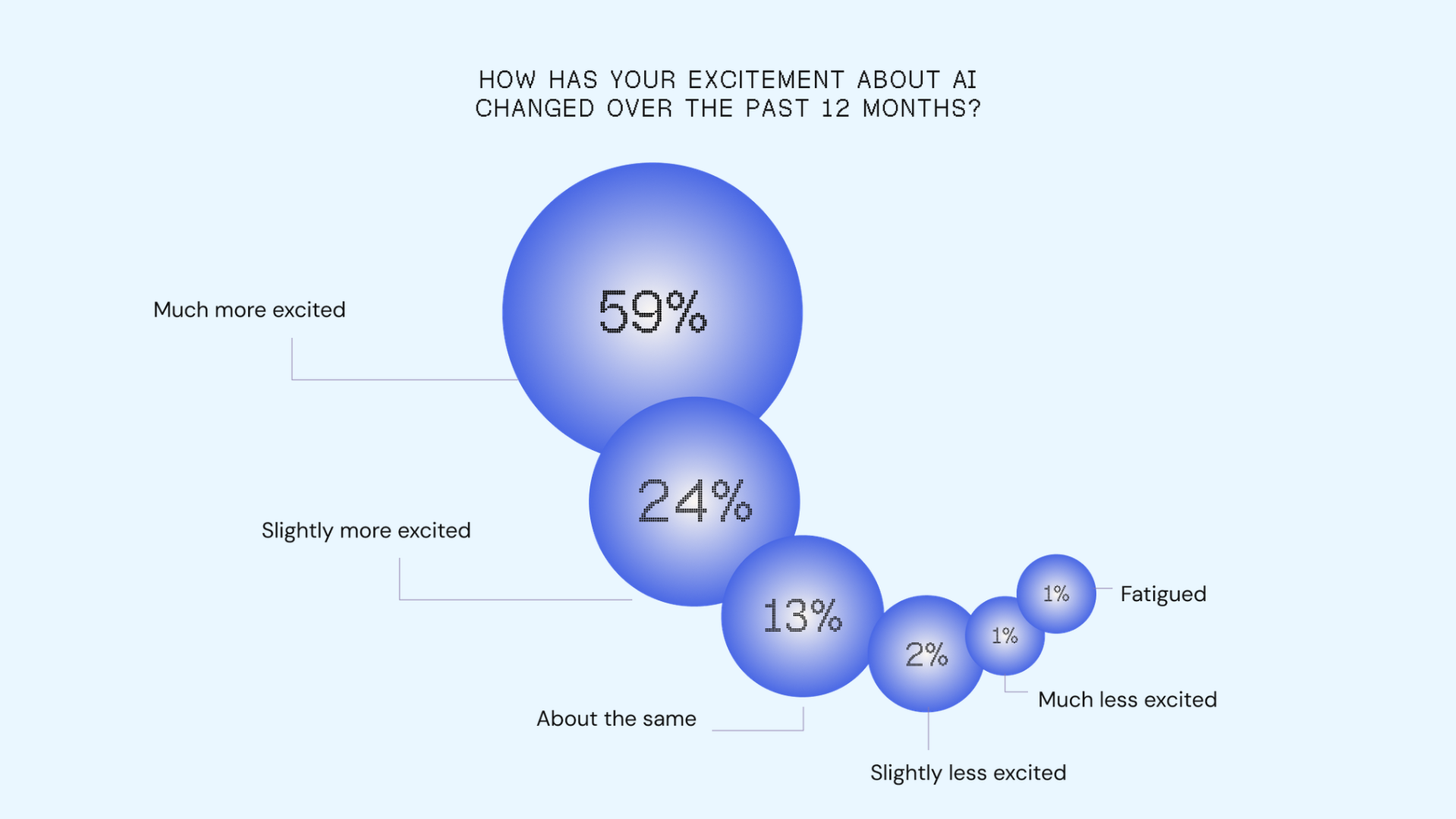
83% of founders in our survey say they're more excited about AI than they were 12 months ago. 59% say they're much more excited because real results have exceeded expectations.
Early-stage founders are constitutionally skeptical of things that don't work. They're too capital-constrained and time-stretched to sustain enthusiasm for anything that doesn’t translate into revenue. When this cohort moves from cautious to convicted, it’s because they’ve found positive evidence.
This growing enthusiasm makes it clear that founders are seeing concrete returns from AI. And they’re choosing to go deeper with 86% planning to increase their AI investment in 2026. Over half of these founders (53%) intend to double it or more.
For a segment of the market that navigated a funding reset with hard-won discipline, this level of commitment comes from the gains made with AI in shipping speed, team output, and product quality. Founders believe AI compresses the cost of experimentation, reduces the advantage of legacy infrastructure, and rewards the agile. Indian startups, lean and fast by design, are structurally well-suited to capture that asymmetry. That’s why 69% of founders agree AI gives startups an unfair advantage over incumbents.
What we find equally important is what these same founders believe AI will not do.
88% disagree that AI will replace most knowledge workers in five years.
They collectively support the idea that AI makes teams faster, more capable, and more ambitious. In doing so, it changes the shape and form of startup teams. The same outputs now require fewer hands, and increasingly, different hands. The ideology is augmentation > substitution. Founders aren't building toward a world where humans are optional and substituted by AI. They're building toward one where employees operate at a higher level of capability, and where that bar keeps rising.
We see this as a sign of the ecosystem's maturity. What’s surfacing is a specific, evidence-based reckoning of what AI does well, where it still falls short, and how to build a company around both.
What this means for founders
When 95% of your peers and competitors are past exploration and racing into active deployment, being “in production” is no longer a differentiator.
We believe the founders who will pull ahead are the ones now asking harder questions: Which parts of my business would break if I removed AI tomorrow? Where am I still using AI as a productivity layer rather than as a structural input into how the company runs?
The settled conviction around AI, now backed by both sentiment and spend, means the conversation over the next 12 months will be about how it drives revenue.
Takeaway 2: Beyond productivity, product is the next frontier for AI adoption
51% of founders consider productivity as AI's most measurable business impact so far, and rightly so. Productivity is where AI delivered first, and where it was easiest to see results quickly. A task that took three hours now takes thirty minutes. A codebase that needed two engineers now needs one and a set of well-prompted tools. The wins were concrete, attributable, and fast.
What's more revealing is how that productivity is actually showing up across functions. It doesn't look the same everywhere.
- In engineering, CTOs report 2-5x improvements in output, and 92% of teams are using AI for code generation. AI-assisted coding is the baseline for engineering teams.
- In product, design assistance has hit 100% adoption among CPOs, and teams are cutting the time from idea to prototype by more than 50%. A week of back-and-forth between designers and developers is an afternoon’s work now.
- In marketing, 100% of CMOs report an increase in content volume, and 100% report an increase in quality. The content faucet is fully open.
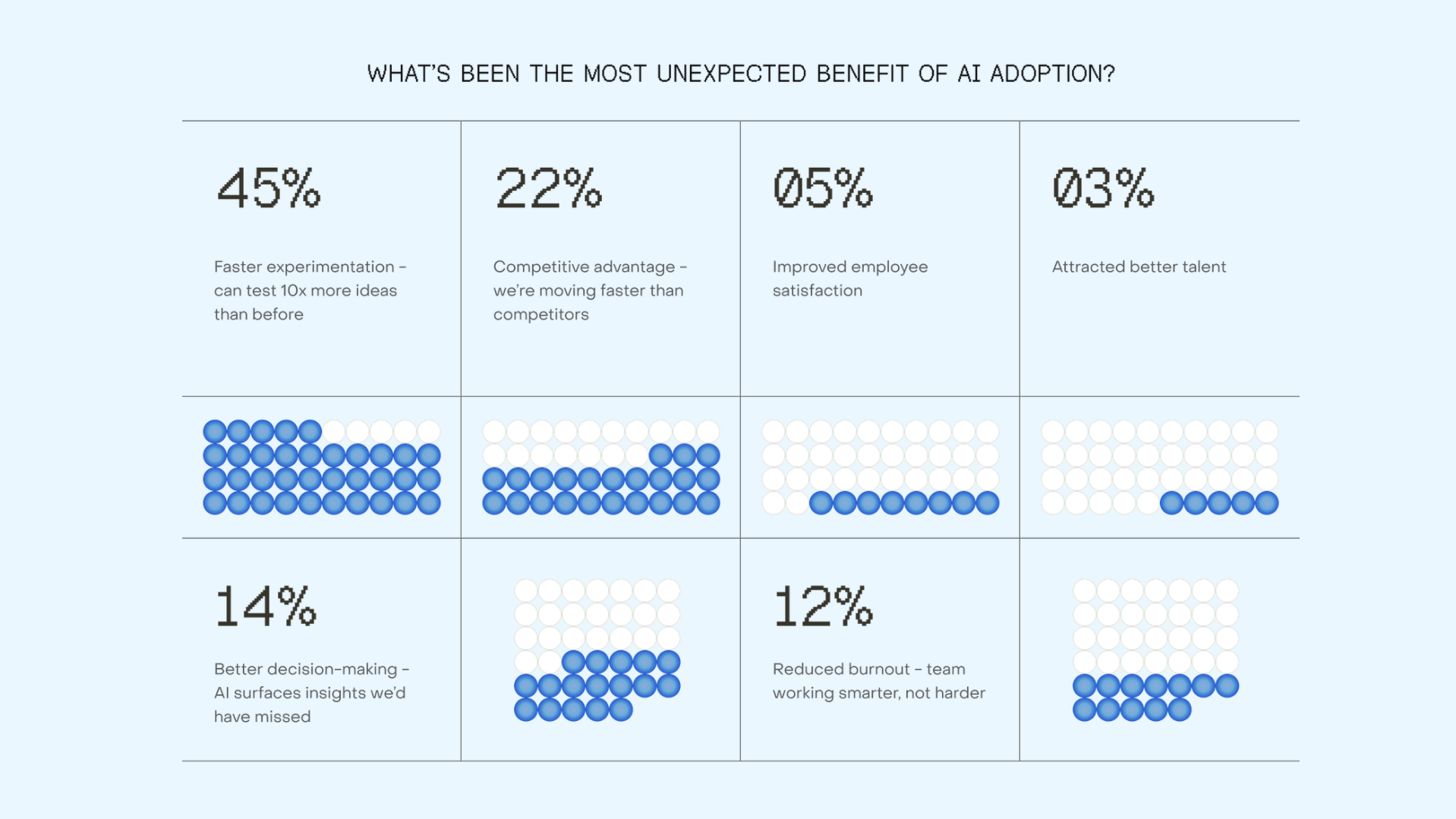
Across every function where AI has taken hold, a clear pattern is visible: creation is faster and iteration cycles are shorter. More importantly, teams can now put more shots on target because you can experiment rapidly and kill bad ideas without draining resources. 45% of founders say the most unexpected benefit of AI is the ability to test 10x more ideas than before.
This acceleration is now cascading the benefits of AI to the end users through product. When teams move faster internally, the natural next step is: what can we now build for our customers that we couldn't before?
This is evident by the fact that 69% of founders list launching customer-facing AI features as a top 2026 priority. Founders don’t have to choose between internal efficiency and external differentiation. They're gunning for both because the capacity freed up by leaner, faster internal operations funds the ambition to build more sophisticated products. The productivity gains make bigger bets possible.
What this means for founders
The move from internal productivity to customer-facing AI requires a deliberate shift in how founders think about their product roadmap. Productivity gains free up engineering cycles and compress timelines, but translating that into AI features users actually trust and return to is a different challenge.
You want to treat customer-facing AI features with the same rigor as any core product decision: clear quality bars before shipping, human checkpoints where the stakes of a wrong output are high, and tight feedback loops to improve over time.
The 45% of founders who cite faster experimentation as AI's most unexpected benefit have already internalized this. Their learning velocity over 12-24 months can eventually show up as product differentiation.
Takeaway 3: The adoption wave is uneven, and the gap tells you exactly where the next opportunities are
AI adoption in Indian startups looks like a steep gradient with a long tail.
Engineering teams have 85% of projects in production. Product follows at 75%. Marketing sits at 48%, operations at 40%, customer support at 29%, sales at 26%, finance at 14%, and HR at 8%.
Three factors explain the wide gap between Engineering and HR.
The first is that the AI ecosystem was built for developers first. Engineers had mature tools, active developer communities, and documented implementation patterns years before anyone was seriously building for finance or HR. The early movers in the AI tooling market (code assistants, LLM APIs, orchestration frameworks) all assumed a technically fluent user as the starting point. That head start compounded. Engineering teams got more tools, faster iteration cycles, and a larger body of shared knowledge about what works in production.
The second is that AI adoption, even with good tools available, is fundamentally a technical endeavor at the implementation layer. Embedding AI into a workflow requires someone who can evaluate outputs, configure prompts, integrate APIs, and debug failures. Functions with engineering proximity, like product, data, design, have made this jump more readily. Functions without it face a steeper ramp regardless of how good the tools are. An operations leader or CFO who wants to use AI in their workflows is often dependent on engineering bandwidth that is already stretched toward higher-priority build work.
The third factor is risk tolerance. 73.7% of functional leaders in HR and Finance functions say they're more excited about AI than a year ago. But they're slow to embrace it because the cost of a wrong output in their context is categorically different. A hallucination in a financial close process or a biased output in a hiring workflow is a massive liability. That means, these functions aren't waiting simply out of reluctance. They're waiting for the tools to earn a level of trust they haven't yet established, and for the ROI to be demonstrated in contexts that resemble their own.
These factors collectively explain why 52% of functional leaders cite “lack of relevant tools” as their primary barrier. The tools simply don't exist yet for their specific workflows. CEOs are directing 45% of their AI budget toward engineering, product, and data—the functions where tools are mature and returns are visible. HR, finance, and operations receive a fraction of that. The investment gap and the adoption gap reinforce each other.
We believe this picture maps the next wave of opportunity for builders.
The functions that are yet to witness an AI facelift account for the majority of operating spend in Indian startups. Think payroll decisions, financial planning, procurement, recruiting, compliance. These are not peripheral workflows. They’re the operational core of every company. And they’re largely untouched by AI today because the ecosystem hasn't built for them yet.
What this means for founders
If you're building an AI product, you’ll face the stiffest competition in crowded markets around development tools. But the functions still waiting for their first truly useful AI tool are underserved, underloved, and sitting on a genuine willingness to pay.
If you're a founder running one of these functions inside your startup, the gap is also an invitation. Teams that invest now in figuring out how AI can work in finance, operations, or HR, even with imperfect tools, will have a meaningful head start when the tools catch up. The ecosystem will build for these functions. The question is whether you're experimenting early enough to use those tools well when they arrive.
Takeaway 4: The workforce is being reshuffled, but with caution
One of the most critical talking points around AI has been its impact on the workforce. The conversation has been a melting pot of ideas around whether AI will take away jobs or not, what kind of roles will take the biggest hit, and what the future holds for the knowledge economy.
Our data is particularly revealing on the impact of AI in the Indian startup workforce.
30% of founders are either freezing hiring in specific functions or actively reducing team sizes. 17% are reducing hiring for entry-level positions, but looking to add more AI specialists. And another 23% are in wait-and-watch mode. But for 29%, there has been no change in the workforce and hiring plans.
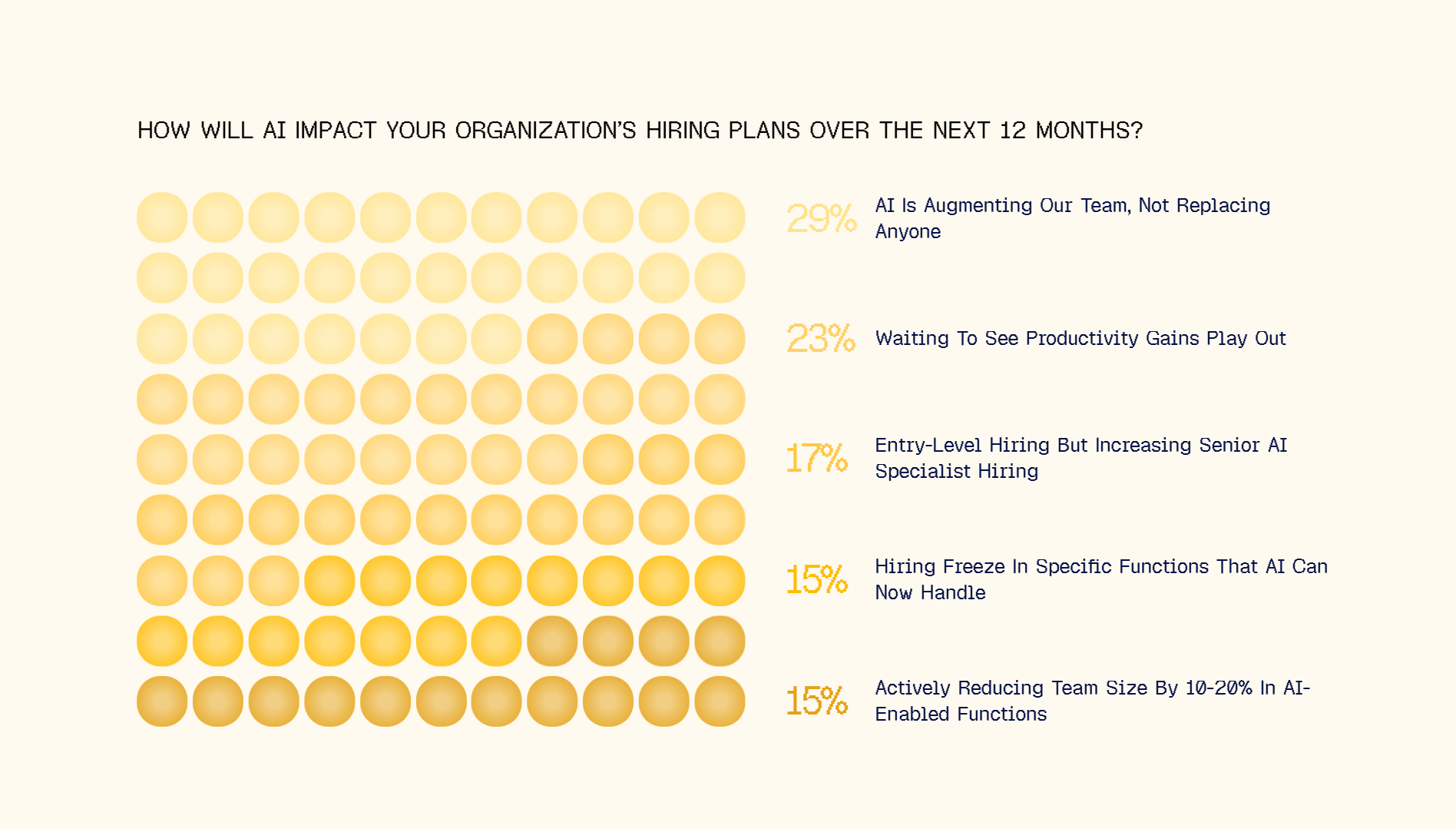
The through-line is that there isn’t any dramatic restructuring at play here. The breakdown by function adds more nuance to this story.
Engineering is the most cited function for hiring reductions, followed by marketing, customer support, and operations. Junior and entry-level roles are bearing the sharpest pressure.
Add to this, we found that the CEO and CTO lens looks very different for workforce changes. CEOs see the macro outcome: the same work now requires fewer people. CTOs see the execution reality: the same work now requires different people. They are simultaneously reducing general engineering roles and adding AI specialists. And that’s where they hit the wall because 43% of CTOs still flag a talent shortage. They're short on engineers who can prompt, evaluate models, orchestrate agents, and build reliable AI systems in production. The talent gap is one of capability, not count.
From our research, it’s clear that the team of 2027 will be smaller in some functions, larger in others, and almost universally different in what it's expected to know and do. Roles that require judgment, context, creativity, and domain expertise are holding their value. Roles centered on execution of repeatable tasks are contracting.
What this means for founders
We believe the moment is ripe for founders to intentionally and strategically rethink team design. Map your org chart against where AI tooling is headed, identify which roles are doing work AI will reliably handle, and find where you need people who can work with AI rather than around it. This is your chance to design a team for 2027 and forge ahead.
Takeaway 5: The cultural battle for AI adoption is over
A year ago, cultural resistance was among the biggest barriers to AI adoption in Indian startups. Our survey shows a decisive inversion to this notion with only 25% of founders citing cultural resistance as a barrier.
What's replaced the cultural barrier is something more structural and, in many ways, harder to solve.
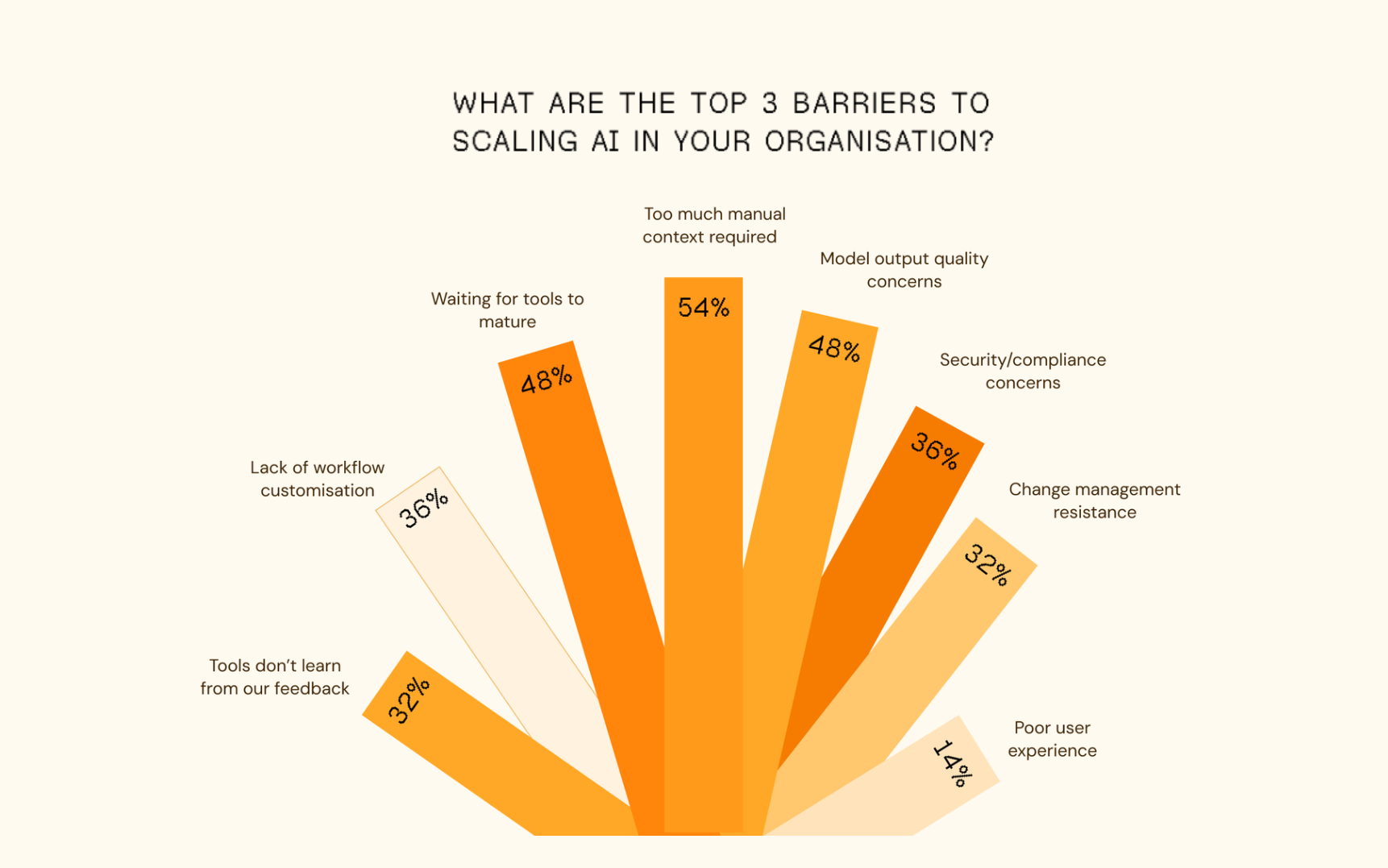
53% of founders cite limited internal bandwidth as the top adoption blocker. In simple terms, teams are too busy to implement the thing that would make them less busy. It’s a genuine catch-22, and there is no simple organizational fix for it. Beyond getting started, the challenges to scaling AI usage across the org comes down to tool capability. 54% say AI demands too much manual context to work reliably at scale, 48% are waiting for the tools to mature, and 48% cite output quality concerns. These are product capability gaps that the current generation of AI tooling has not yet fully closed.
Beneath these structural barriers, something else is happening at the individual level.
43% of founders say AI adoption is being driven by individual employees discovering and championing tools on their own. Function-level champions follow at 33%. The adoption that actually sticks inside Indian startups is not mandated from above anymore. It’s being built from below, by people who found a better way to do their work and made it visible to others.
The employees driving AI adoption inside their teams are becoming more productive and simultaneously. they are:
- Building institutional knowledge about what works
- Developing the skills to evaluate and direct AI outputs
- Positioning themselves as the people their organizations depend on when the next capability arrives
The cultural moment is genuinely open in a way it rarely is. In most technology transitions, the early advantage accrues to those with access to tools, to training, to organizational support. The current AI transition is different. The tools are broadly accessible, the barriers to experimentation are low, and the employees who are pulling ahead are largely doing it on their own initiative.
What this means for founders
The cultural sell is done. The operational infrastructure for learning at scale is what most teams are still missing.
We believe the teams that will pull ahead are the ones with the organizational conditions for bottom-up adoption to travel upward. That means creating space for experimentation and building lightweight structures for sharing what works through playbooks, champions, internal demos. It also means treating individual AI wins as institutional assets rather than personal productivity hacks.
Looking ahead
These five big findings converge on a clear picture. Indian startups have crossed a threshold. AI adoption is no longer the goal. It's the baseline.
We built this research to capture the ground reality of where Indian startups stand today. What it tells us, above all, is that the most consequential decisions and progress will happen in the next 12 months.

.png)